ManyChat AI Agent




A production-shaped, provider-agnostic AI agent that answers customer questions on WhatsApp through ManyChat, escalating to a human rather than guessing.
Switching the model is one environment variable. Switching the chat platform is one adapter.
It is for anyone putting an LLM behind a platform that enforces a hard webhook timeout: ManyChat is the adapter that ships, and the race and the outbox below are what carries over to any other.
git clone https://github.com/pedronastasi/manychat-ai-agent.git
cd manychat-ai-agent
pnpm install && pnpm bootstrap && pnpm dev
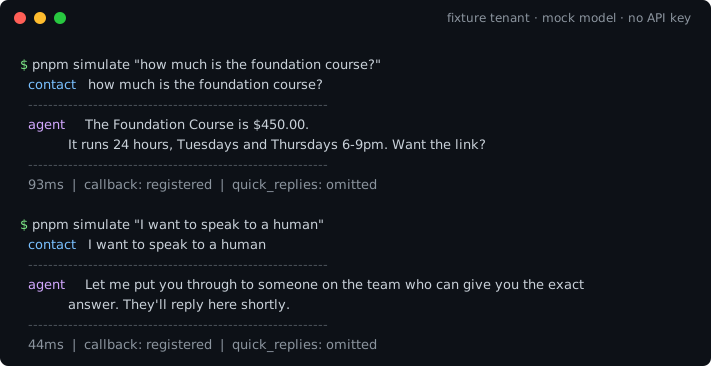
That runs with no API key and no database to install — an offline mock model and an embedded PGlite Postgres. In another terminal, pnpm simulate answers one question and hands one off:
The problem this solves
ManyChat can call an external endpoint, but it terminates the request after 10 seconds. An LLM call plus database work sometimes fits in that budget and sometimes does not, so the obvious synchronous design drops replies under exactly the conditions where a customer is already waiting.
This project takes the position that neither "always answer inline" nor "always queue" is right, and races them.
inbound message
     │
     ├─ guards: keywords, turn cap, rate limit, daily budget ── denied ──▶ escalate to human
     │                                                                     (model never runs)
     ▼
  Promise.race
     ├── model answered  (< 8s) ──▶ reply inline + re-register callback
     │
     └── deadline hit    (= 8s) ──▶ short ack
                                     │
                                     └─ model keeps running ──▶ outbox ──▶ worker ──▶ Send API
The losing model call is not cancelled. Those tokens are already paid for and the answer is still wanted, so it completes into a Postgres outbox and a worker delivers it seconds later. The reply is never dropped, only deferred.
The conversation loop lives in this service rather than in ManyChat's visual flow builder, via Dynamic Block's external_message_callback. That is what keeps the agent portable instead of welded to one vendor's UI.
Design decisions
Every non-obvious choice is written down in docs/adr/:
| ADR | Decision |
|---|---|
| 0001 | Race the model against a deadline instead of choosing sync or async |
| 0002 | One registry module may import providers; everything else uses a port (superseded) |
| 0003 | Zod schemas generate both the types and the OpenAPI document (superseded) |
| 0004 | A Postgres outbox, not Redis — one datastore, transactional enqueue |
| 0005 | Define the channel port, ship exactly one adapter |
| 0006 | ManyChat does not sign webhooks; the compensating controls, written down (superseded) |
| 0007 | generateObject, not a tool loop, while there are no tools (superseded) |
| 0008 | Ports are implemented by classes; functions stay for pure transformation |
| 0009 | Identifiers are at least two characters, enforced by lint |
| 0010 | A two-step tool loop whose tools stage actions; the server performs them after guardrails |
| 0011 | A judge model grades evals only in a run where it first agrees with hand-labelled calibration |
| 0012 | Each contact has a token held by ManyChat; only a request carrying it reads that contact's history |
| 0013 | History reaches back 30 days; the turn cap resets after 24 hours of silence |
| 0014 | Logs identify a contact by the conversation's random ID, not a hash of the subscriber ID |
| 0015 | The agent takes a lead to the payment link itself; every C6 limit on what it may claim stays |
| 0016 | Read tools are performed when called and the loop grows to four steps; writes are still staged |
| 0017 | Free text only in declared note fields no flow renders, length-capped and stripped of identifiers |
| 0018 | Port to Python on LangChain, LangGraph, FastAPI and Pydantic, cut over beside TypeScript on one database |
| 0019 | On an inbound turn a flow is sent when the model calls it, so the reply follows it; other writes stage |
| 0020 | Learning is offline, from paid outcomes; a tactic reaches the prompt only after approval and an eval |
| 0021 | A tenant depends on one published package and starts from a scaffolder; nobody forks to deploy |
Behavior is specified before it is implemented, in specs/ — a constitution of non-negotiables, the agent's behavior, and the channel contract. Tests cite the clause they enforce.
Model agnosticism
No module imports a provider package except src/agent/registry.ts. The active model is a string:
AGENT_MODEL=anthropic:claude-haiku-4-5   # default
AGENT_MODEL=openai:gpt-5-mini            # same behavior, zero code changed
AGENT_MODEL=google:gemini-2.5-flash
AGENT_MODEL=ollama:llama3.1:8b           # local, free — see "Local model" below
AGENT_MODEL=mock:demo                    # offline, deterministic, free
Callers depend on an AgentRunner port, not on the AI SDK, so replacing even the SDK is contained to one file.
What makes it production-shaped
Fails closed, toward a human. Low model confidence, a schema violation, an exhausted budget, a rate limit, or a provider outage all escalate. The agent never invents a price — an unanswerable question is a handoff, by design.
Untrusted input, treated as such. Contact text is fenced and labelled as data, with the fence markers stripped first so they cannot be forged. Model output is validated before any of it reaches a customer, and replies that leak the prompt are dropped. The golden set includes injection attempts.
A contact's history is theirs, not whoever names them. The shared secret proves a request came from the flow, not which contact it speaks for. Each contact has a random token kept in their own ManyChat custom field and stored here only as a hash. A request without it is answered from its own message alone, so a leaked secret does not expose anyone's conversation (spec 019).
Spend is bounded. Every turn records tokens, cache hits, and estimated cost. Daily token and dollar caps degrade to escalation rather than to an error — a bill cap that fails into a human is the correct failure mode for a business.
Channel constraints are data, not memory. Quick replies silently do nothing on WhatsApp; ManyChat accepts them and the contact never sees them. That lives in a ChannelCapabilities value with a test, not in a comment someone forgets.
No PII in logs. Redaction is configured at the logger, so a new log statement cannot opt out. Telemetry spans omit prompts by default. Log lines name a conversation by its random ID, never by anything derived from the subscriber.
An eval harness. pnpm eval replays a labelled golden set through the current prompt and asserts escalation behavior, price grounding, prompt leakage, and latency — then prints every reply, because a green suite whose tone has drifted is still a failure and only a person can see that.
Layout
specs/            behavior specified before implementation
docs/adr/         why each decision was made
src/
  contracts/      Zod schemas — the single source of truth
  agent/          registry (the only provider import), runner, prompt, guardrails
  channels/       the port, plus the ManyChat adapter and a local simulator
  conversation/   store, rate limits, budget caps
  media/          voice notes, images and videos: resolver and ffmpeg splitter
  outbox/         deferred delivery
  routes/         auth, the turn handler with the race
evals/            golden set + runner
test/             unit and integration (PGlite: real Postgres, no container)
Development
pnpm bootstrap         # local config + .env from the committed examples
pnpm dev           # offline by default: mock model, embedded Postgres
pnpm simulate "…"  # send a Dynamic Block request as ManyChat would
pnpm test          # unit + integration
pnpm eval:mock     # golden set, offline and free
pnpm lint && pnpm typecheck
Integration tests run against PGlite — real Postgres compiled to WASM, in process — so FOR UPDATE SKIP LOCKED, upserts and constraints behave as in production with no container to start in CI.
Local model
Run a real model locally via Ollama — free, no API key, useful for testing the model boundary (schema adherence, latency, judgment) without incurring API costs.
docker compose --profile local-model up        # starts Ollama alongside Postgres
AGENT_MODEL=ollama:llama3.1:8b pnpm simulate "hello"
The first run pulls ~4.7 GB of weights; they persist in a named Docker volume so subsequent starts are instant. Any Ollama-supported model works — just use the tag from ollama list:
AGENT_MODEL=ollama:gemma3:4b pnpm simulate "how much does the course cost?"Inside Compose the agent reaches Ollama at http://ollama:11434/v1. Running locally (outside Docker), it defaults to http://localhost:11434/v1; override with OLLAMA_BASE_URL if needed.
Ollama models price at zero, so the daily dollar cap never fires. The token cap still applies and guards against runaway loops. The 8 s race deadline means the deferred path (acknowledge now, push the real answer later) becomes the default for slower local models — that is by design.
Running the full stack with Docker
Everything below uses the mock model (free, deterministic, no API key). To use a real cloud model, set AGENT_MODEL and the matching API key in .env before step 3.
1. Clone and bootstrap
git clone https://github.com/pedronastasi/manychat-ai-agent.git
cd manychat-ai-agent
pnpm install && pnpm bootstrap
pnpm bootstrap copies the example configs and .env. Everything in config/ is gitignored, so tenant data never reaches version control.
2. Set a shared secret
Open .env and replace the placeholder MANYCHAT_SHARED_SECRET with a real value — any string of at least 16 characters. This is the bearer token you will use in curl:
# generate one if you like
openssl rand -hex 32
3. Start the containers
docker compose up --buildThis starts Postgres 18 and the agent. Wait for the log line:
{"level":30,"msg":"Server listening at http://0.0.0.0:3000"}4. Chat with the agent
The agent exposes one endpoint: POST /v1/channels/manychat/message. It expects a ManyChat Dynamic Block payload — a JSON body with at least subscriber_id and text — and an Authorization: Bearer <secret> header.
Ask about course prices:
curl -s http://localhost:3000/v1/channels/manychat/message \
  -H 'Content-Type: application/json' \
  -H 'Authorization: Bearer <your-secret-from-.env>' \
  -d '{"subscriber_id": "test-001", "text": "how much is the foundation course?"}' \
  | jq .
The response is a Dynamic Block v2 object. The agent's reply is in .content.messages[].text:
{
  "version": "v2",
  "content": {
    "messages": [
      { "type": "text", "text": "The Foundation Course is $450.00." },
      { "type": "text", "text": "It runs 24 hours total. Want the enrolment link?" }
    ],
    "external_message_callback": {
      "url": "https://agent.example.com/v1/channels/manychat/message",
      "method": "post",
      "headers": { "Authorization": "Bearer ..." },
      "payload": {
        "text": "{{last_input_text}}",
        "subscriber_id": "{{contact.id}}",
        "ai_token": "{{ai_token}}"
      },
      "timeout": 86400
    }
  }
}
The external_message_callback is what keeps the conversation alive: ManyChat sends the contact's next message back here, rather than falling through to its own flow, with their token filled in from their custom field.
Continue the conversation (same subscriber_id):
curl -s http://localhost:3000/v1/channels/manychat/message \
  -H 'Content-Type: application/json' \
  -H 'Authorization: Bearer <your-secret-from-.env>' \
  -d '{"subscriber_id": "test-001", "text": "yes, send it"}' \
  | jq .content.messages
This remembers the first question because pnpm bootstrap sets CONTACT_TOKENS_ENFORCED=false. Locally there is no ManyChat field to hold the contact's token, so curl has none to send. With it true, as in production, a request without the token is answered from its own message alone.
Trigger an escalation:
curl -s http://localhost:3000/v1/channels/manychat/message \
  -H 'Content-Type: application/json' \
  -H 'Authorization: Bearer <your-secret-from-.env>' \
  -d '{"subscriber_id": "test-001", "text": "I want to speak to a human"}' \
  | jq .content.messages
Healthcheck:
curl http://localhost:3000/health
curl http://localhost:3000/ready
5. (Optional) Use a local model
To test with a real model for free, add Ollama:
docker compose --profile local-model up --buildThen set AGENT_MODEL=ollama:llama3.1:8b in .env and restart the agent container (docker compose up --build agent). The first run pulls ~4.7 GB; subsequent starts are instant.
With a local model, responses typically take 9–120 s, so the deferred path fires on most turns: the agent sends an acknowledgement within 8 s, and the full reply arrives later via the outbox worker.
Using pnpm simulate instead of curl
If you prefer running outside Docker (pnpm dev), the simulator wraps the same request and formats the output:
pnpm simulate "how much is the foundation course?"
pnpm simulate --subscriber 42 "can you give me a discount?"
Deployment
Point a ManyChat Dynamic Block (Dev Tools, requires a Pro plan) at POST /v1/channels/manychat/message and add an Authorization: Bearer <secret> header matching MANYCHAT_SHARED_SECRET. The OpenAPI document is generated from the same schemas that validate at runtime.
Create a Text custom field named ai_token (or whatever MANYCHAT_TOKEN_FIELD names), then send it as a top-level key of the Dynamic Block's request body, next to the keys you already send:
{
  "subscriber_id": "{{contact.id}}",
  "text": "{{last_input_text}}",
  "ai_token": "{{ai_token}}"
}
Insert the value with ManyChat's variable picker rather than typing it, so it points at the field. The key is always ai_token; any key the service does not know is refused with a 400. Nothing else needs configuring: the callback the service registers asks for the same field.
Contact tokens
- The token never appears in a response or a log line. It reaches the contact's field only through ManyChat's API, so the only way to present it is to be the contact ManyChat sends it for.
- An unbound request repairs itself. It also writes a fresh token to the contact's field, at most once an hour. That fixes a cleared field or a failed write, and a forger triggering it gains nothing, because the token goes only to the real contact.
- The previous token stays valid until the next one is issued, so a message sent while a new token is being written still binds.
- A failed write is retried by the outbox worker with a fresh token. The token itself is stored nowhere but the contact's field.
Turning tokens on for a deployment that already has contacts takes a flag and a backfill, in that order, or everyone loses their context at once. The five steps are in spec 019; pnpm tokens:backfill (node dist/backfill.js in the image) is step 2, and its --check is step 4.
Voice notes, images and videos
WhatsApp media reaches the service as a link in text. The service downloads the file itself, and the link is never stored, logged or shown to the model (spec 020):
- A voice note is transcribed by
TRANSCRIPTION_MODELand then treated as typed text, escalation keywords included. - An image goes to the answering model once, as bytes. History keeps
[image]in its place. - A video is split by ffmpeg, which is part of the image, into up to four frames and a transcript of its soundtrack.
Whatever it cannot read gets rules.messages.mediaFallback, which asks the contact to type. Without that message, the turn hands off to a person. A failed download or transcription always hands off. The boot log's media capabilities line shows what this server can read.
Agent tools
With an optional config/tools.json, the agent can also act on the contact in ManyChat: send one of the tenant's flows, add or remove a tag, or record one of a field's allowed values (spec 012). It can also read what is recorded on the contact and write short notes for the team (spec 024).
A turn where the contact asks for something to read, answered inside the deadline (spec 029):
When the model misses the deadline, the contact gets the holding message; the flow has already gone out, and the outbox worker delivers the reply after it.
- A flow goes out when the model sends it (ADR-0019). The model is told whether ManyChat accepted it and writes its reply after, so the contact reads the flow, then the reply, then its question. A handoff later in the turn cannot recall it. A payment link takes the turn's stage writes with it, so
link_sentis the last stage ManyChat is given. A nudge turn keeps its flows staged. - Every other tool call only stages the action. Tags, fields, notes and nudges reach ManyChat after the reply has gone out, either as the Dynamic Block response or through the outbox, and a turn that ends in a handoff discards them. A turn has at most four model steps and eight actions, and each action gets one attempt.
- The model only picks from the config. It names entries by
id, never a ManyChat name or free text, and every action lands on the contact whose message it is answering. - Every action is recorded on its turn with what became of it, and the next turn's history tells the model what it already sent.
Reading the contact and writing notes
get_contact is the one tool performed while the model runs (ADR-0016): reading changes nothing on the contact, so there is nothing for a handoff to undo. write_note stages free text like any other write (ADR-0017).
- A read returns a whitelist. The client parses ManyChat's
getInfodown to tag names and field values, so the contact's name, phone and email never reach the model. It returns only the tags, fields and notestools.jsonlists, by id. A field holding a value outside its list reads asother. - Notes come back fenced. A note summarises the contact's words, so it is returned inside the same fence as their messages and treated as data (C4).
- A read never blocks the reply. It gives up after 1.5 seconds and returns
{ available: false }, and the turn goes on. A turn reads at most twice, and only when it carries the contact's token (specs/019). - Notes are bounded and cleaned. A note field must be declared
"neverRendered": trueand capped at 500 characters. Links, emails, phone numbers and long numbers are replaced by[removed]before it is staged. The turn record holds the note's length, never its text, and so do the logs. - A handoff summary survives the handoff. A note marked
onEscalationis still written after the escalation message, but only when the model or the confidence threshold escalated. On a leak, an invalid reply or a failed call it is discarded with everything else.
Following up on a quiet contact
With a nudge section, the agent can also schedule one follow-up for a contact who goes quiet (spec 025). A worker checks at due time that the contact has not written, no person has taken over, the sale is not closed and WhatsApp's 24-hour window is still open. Only then does it run a model turn on a system note in place of a message. The model may decline, and then nothing is sent. Otherwise the follow-up goes out through the outbox, and it never schedules another.
How to configure tools and follow-ups, read the record, and what to check before enabling them is in config/README.md.
Sales funnel
With a funnel field and a payment-link flow in tools.json, the agent takes a new lead from their first reply to the payment link instead of only answering questions (spec 023, ADR-0015). It replaces a drip sequence: each piece the drip used to send on a timer becomes a flow the agent sends when the conversation calls for it.
The agent records where the sale stands in a ManyChat field, one stage at a time:
- The stage only moves forward. A write to an earlier stage than the last one performed is refused, so a confused turn cannot send a lead back to
qualifyingafter the offer. The model is told the contact's current stage on every turn. - The agent qualifies before it sends content, one question per turn, and records each answer with
set_field. A direct question is answered first, and a contact who asks for the link gets it, qualified or not. - Each flow is sent at most once per contact within the history window. A flow already performed is removed from the model's choices on the next turn, unless it is marked
repeatable, as the payment link usually is. - The server, not the model, writes
link_sent. It is a follow-on of the payment-link flow: it runs only once ManyChat accepted the flow, and a failed flow writes no stage. It does not count against the eight-action cap. - Objections are answered from the catalog. "Too expensive" or "can I pay in parts?" gets the catalog's
paymentOptions; "I don't have time" gets the content flow that addresses it. A discount request that no payment option answers still escalates asprice_negotiation. - It asks for the sale, and never invents a reason to buy now. Once the stage is
offered, the closing question asks for the enrolment plainly. No invented scarcity or deadline, no promised job outcome, no price absent from the catalog: a deposit or instalment figure is allowed only because it is inpaymentOptions. - Payment is a person's job. A contact who says they have paid, or sends a receipt, is escalated as
payment_reported. The agent cannot see the payment and never confirms it.
The stage rules are system instructions, the same for every tenant. How the agent sounds while selling is the tenant's, in config/prompt.md and each flow's description. Setup, the rollout checklist and how to measure the result are in config/README.md.
Configuration is files, not code: config/catalog.json holds every fact the agent may state, so a price change is a JSON edit and kill -HUP. Nothing in config/ is ever committed.
Status
MVP. Answers, escalates, and can send a tenant's ManyChat flows, tags and field values; it does not book or take payment. The AgentRunner port exists so adding those does not change any caller.
License
MIT — see LICENSE.